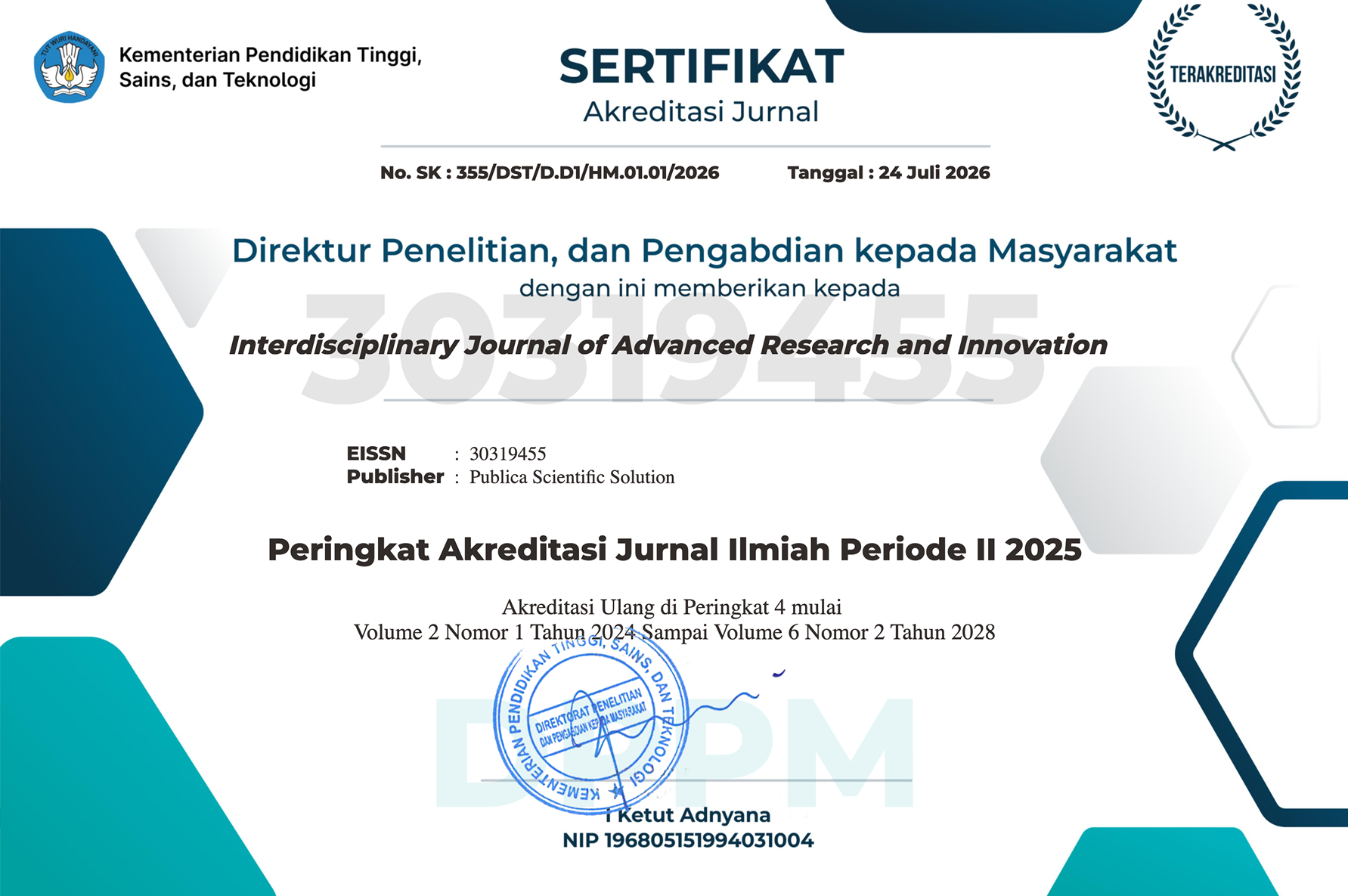
Legal Certainty of Authentic Deeds Drawn up By Notaries Violating the Dual Office Holding Prohibition Pursuant to Article 17 of Law No. 2 Of 2014 on Notary Positions
DOI:
https://doi.org/10.58860/ijari.v4i2.106Keywords:
dual office, notary, authenticity, legal certaintyAbstract
Notaries are public officials authorized to draw up authentic deeds. However, violations of the prohibition on holding dual offices under Article 17 of Law No. 2 of 2014 continue to occur, including cases in which notaries concurrently practice as advocates or engage in other prohibited professions, sometimes by attempting to circumvent the prohibition through formal leave. This article aims to analyze violations of the prohibition on dual office holding by notaries and examine their legal consequences for the legal certainty of the deeds they draw up, using the Theory of Authority to assess the legality of actions performed by public officials and the Theory of Legal Certainty to evaluate the authenticity of the resulting legal instruments. This normative juridical study employed statutory, conceptual, analytical, and case approaches. Data were collected through a literature review and analyzed using a qualitative-deductive method. The findings indicate that the validity of an authentic deed requires the cumulative fulfillment of formal and substantive requirements and that compliance with the prohibition on dual office holding forms part of the formal requirements governing a notary’s authority. If a notary is proven to hold a prohibited concurrent position, including through circumvention by taking formal leave, the notary’s legal authority to act may be deemed impaired. Consequently, pursuant to Article 1869 of the Civil Code, the deed may lose its status as an authentic deed and instead have the evidentiary value of a private deed, irrespective of the substantive correctness of its contents. Furthermore, supervision by the Notary Supervisory Council remains suboptimal and largely reactive. The legal defect in the deed therefore arises from the impairment of the notary’s authority at the time the deed was drawn up. Notaries are advised to comply strictly with their oath of office and statutory obligations in order to preserve the legal certainty of the deeds they produce.
References
Adjie, H. (2009). Observing the Treasures of Notaries and PPAT Indonesia. Refika Aditama.
Adjie, H. (2014). Indonesian Notary Law (Thematic Interpretation of the Notary Position Law). Refika Aditama.
Adjie, H. (2017). Civil and Administrative Sanctions against Notaries as Public Officials. Refika Aditama.
Agustina, R. (2003). Unlawful Acts. Graduate Program of FH UI.
Ali, A. (n.d.). Uncovering Legal Theory and Judicial Theory. Kencana.
Ali, Z. (n.d.). Legal Research Methods. Sinar Grafika.
Amiruddin, & Asikin, Z. (2010). Introduction to Legal Research Methods. Rajawali Press.
Anshori, A. G. (2016). Indonesian Notary Institute Legal and Ethical Perspective. UII Press.
Ayumi, R. N. (2022). Juridical Analysis of Notaries Concurrently Serving as Chairman of Political Parties. University of North Sumatra.
Badrulzaman, M. D. (n.d.). Civil Code Book III of the Law of Engagement with Explanation. Alumni.
Budiono, H. (n.d.). A Collection of Civil Law Writings in the Field of Notary. Citra Aditya Bakti.
Fauzi, A. (2023). The Power of Proving Authentic Deeds in the Indonesian Civil Law System. Menara Ilmu: Scientific Journal of Postgraduate Students, X(2), 12.
Fuady, M. (n.d.). Contract Law. Citra Aditya Bakti.
Halim, B. R. (2020). Harmonization of the Law on the Arrangement of Dual Notary Positions as Members of the House of Representatives. Universitas Brawijaya.
Hs, S. (2015). Techniques for Making Deed One (Theoretical Concept, Notary Authority, Form and Part of Deed). Rajawali Press.
Hs, S. (2018). Regulation of the Notary Position. Sinar Grafika.
HS, S. (n.d.). Contract Law: Theory and Techniques of Contract Drafting. Sinar Grafika.
Government Regulation Number 37 of 1998 concerning Regulations on the Position of Land Deed Making Officials, (1998).
Law Number 18 of 2003 concerning Advocates, (2003).
Law Number 30 of 2004 concerning the Position of Notary, (2004).
Law Number 2 of 2014 concerning Amendments to Law Number 30 of 2004 concerning the Position of Notary, (2014).
Kie, T. T. (2007). The Study of Notary and Miscellaneous Notary Practice. Ichtiar Baru Van Hoeve.
Kusumaatmadja, M., & Sidharta, B. A. (2000). Introduction to Law. Alumni.
Lumban Tobing, G. H. S. (1999). Regulations of the Notary Position. Erlangga.
Marzuki, P. M. (n.d.). Legal Research. Kencana.
Marzuki, P. M. (2008). Introduction to Law. Kencana.
Master of Notary Study Program Team, J. U. (2024). Guidebook for Writing a Master of Notary Thesis at Jayabaya University. Master of Notary at Jayabaya University.
Mertokusumo, S. (n.d.). Indonesian Civil Procedure Law. Liberty.
Mertokusumo, S. (2009). Legal Discovery. Liberty.
Muhammad, A. K. (2006). Ethics of the Legal Profession. Citra Aditya Bakti.
Decision of the Central Supervisory Council Number UM. MPPN.06.15-55 dated June 4, 2014, (2014).
Decision of the Notary Central Supervisory Council Number 15/B/MPPN/XII/2017, (2017).
Decision of MPPN Number 06/B/MPPN/IX/2018, (2018).
Notary Code of Ethics of the Indonesian Notary Association. (n.d.).
Decision of the Regional Supervisory Council of Notary Provinces of DKI Jakarta Number 1 and 2/PTS/Mj.PWN.Prov.DKI.Jakarta/XI/2017, (2017).
Pradana, K. (2024). Legal Consequences on the Implementation of Dual Positions by Notaries (Case Study: Simulation of Dual Positions of Notary C). Master of Notary Study Program, Faculty of Law, University of Indonesia.
Purnayasa, A. T. (2018). The Legal Consequences of the Degradation of Notary Deeds that Do Not Meet the Requirements for Making Authentic Deeds. Acta Comitas: Journal of Notary Law, 3(3), 396–398.
Rahardjo, S. (n.d.). Progressive Law. Kompas.
Randi, M. A. (2021). Juridical Review of the Dual Position of Notary as the Head of a Private Business Entity. Sriwijaya University.
Sjaifurrachman, & Adjie, H. (2011). Aspects of Notary Accountability in Making Deeds. Mandar Maju.
Subekti, R., & Tjitrosudibio, R. (2008). Civil Code. Pradnya Paramita.
Sutedi, A. (2010). Notary Law and PPAT. Sinar Grafika.
Tambunan, A. U. (2020). Supervision of Notaries Concurrently in Office by the Notary Supervisory Council. UNISSULA.
Tedjosaputro, L. (2001). Professional Ethics of Notaries. Faculty of Law, Gadjah Mada University.